
The Real Cost of the Cheapest Machining Quote
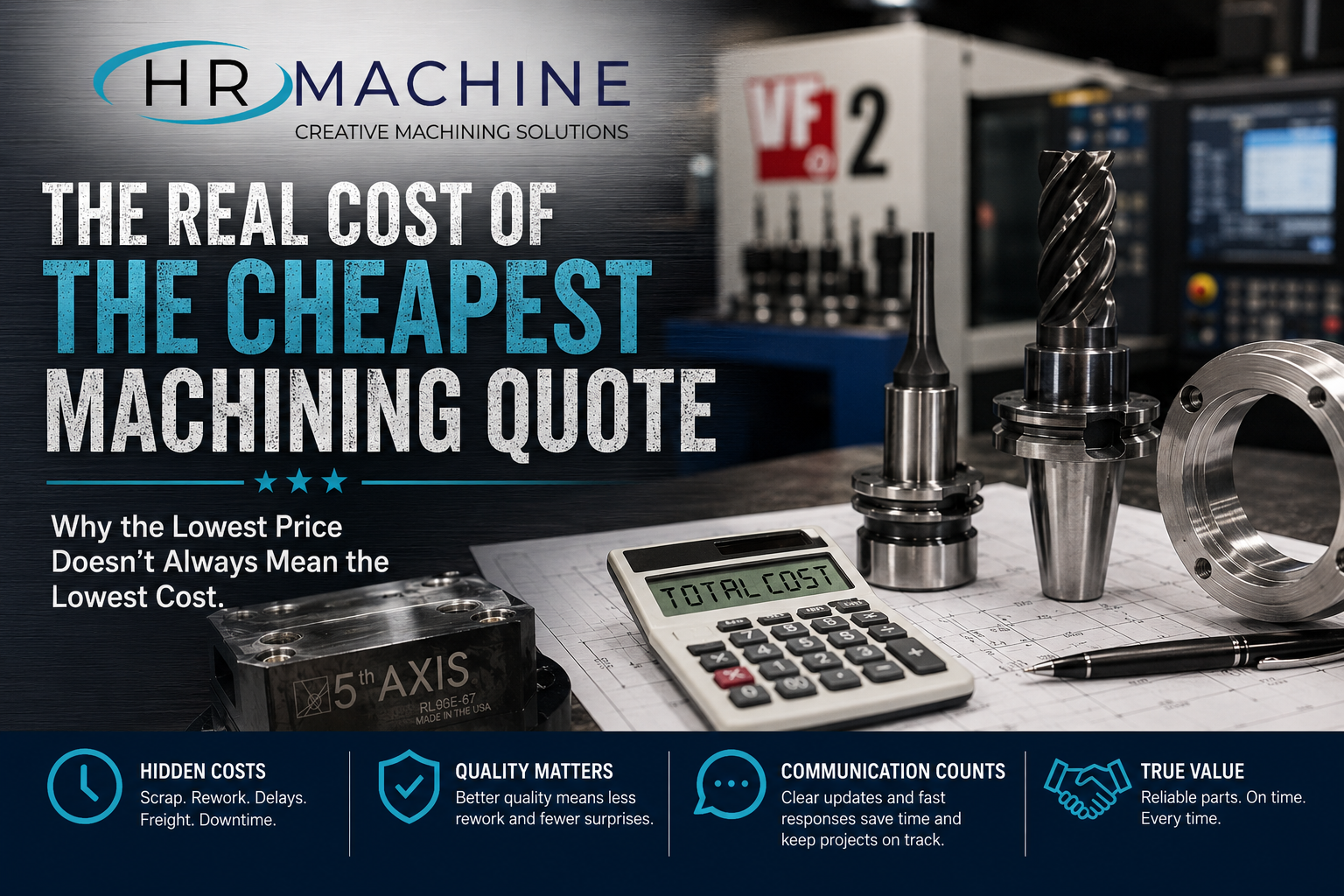
When sourcing machined parts, it is natural to compare quotes by looking at one number first: the price.
That number matters. But it does not always tell you what the job will actually cost.
A lower machining quote looks attractive at the start, but can become expensive later if it leads to scrap, rework, delays, extra freight, engineering headaches, or downtime. The better question is not always, “Who gave us the lowest quote?”
It is: “What will this part actually cost us by the time the job is complete?”
Let’s break it down together..
‘Price Per Part’ Is Only Half the Story
Two machine shops can quote the same price up front, and then end it with very different costs.
That doesn’t automatically mean the higher quote is overpriced or the lower quote is the better value.
Different shops may be accounting for different levels of inspection, setup, tooling, programming, material sourcing, packaging, and scheduling. A higher upfront price may include processes that reduce the chance of problems later. Be sure to ask questions and pay close attention.
This becomes especially important with tight tolerances, complex geometries, difficult materials, or parts that are critical to production.
Scrap and Rework Can Erase Savings Fast
Say one quote saves you $10 per part on a 100-piece order. On paper, that is a $1,000 savings!
But if several parts arrive out of tolerance and need to be remade, sorted, reinspected, or modified, that savings can disappear quickly. Someone now has to identify the problem, communicate with the supplier, determine what can be salvaged, and arrange replacements.
The true cost of a quality issue is rarely limited to the defective part itself. It can also include engineering time, inspection time, production interruptions, administrative work, and expedited replacement costs.
Missed Deadlines Have a Cost Too
A late part can create consequences far beyond the purchase order.
If another operation is waiting on that component, a delay can affect assembly schedules, customer commitments, machine availability, and labor planning. In some cases, one missing component can hold up an entire piece of equipment.
That is why lead time should be evaluated alongside price.
A slightly higher machining cost may be far less expensive than having production waiting several days for a critical part.
Freight and Expedites Add Up
Shipping is another cost that can get overlooked.
If a supplier misses a delivery window, standard freight can suddenly become overnight or same-day freight. Heavy machined components are not inexpensive to expedite.
There can also be added costs when parts need to be shipped back for correction or moved between multiple vendors because one supplier cannot complete all of the required operations.
Every extra handoff creates more time, more freight, and more opportunity for delays.
Your Engineering Team's Time Has Value
Some suppliers simply require more management than others.
Constant clarification emails, missing documentation, unclear status updates, repeated print questions, and recurring quality issues all consume time.
If an engineer or purchasing manager spends hours managing a supplier, that labor is part of the real cost of doing business with that shop.
Strong communication may not appear as a line item on a machining quote, but it has real value.
A shop that reviews prints carefully, asks the right questions early, and communicates potential problems before production begins can prevent a lot of wasted time.
Minimum Quantities Can Create Unnecessary Inventory
A low unit price may also come with a high minimum order quantity.
If you only need 25 parts, buying 100 just to reach a lower price does not always create savings.
The additional inventory ties up cash, takes up space, and may eventually become obsolete if a design changes.
This is one reason flexible production quantities and short-run machining can be valuable, especially for prototypes, replacement parts, and changing production needs.
The Most Expensive Part May Be the One You're Waiting For
For maintenance teams and manufacturers, downtime can outweigh nearly every other cost on the quote.
When equipment is down because of a damaged or unavailable component, the price of machining the replacement part may be small compared with the cost of lost production.
In those situations, responsiveness, problem-solving ability, and turnaround time can matter far more than saving a few dollars on the part itself.
At HR Machine, the goal is not simply to put a number on a print. It is to understand what the part needs to do, how it fits into the larger project, and how to manufacture it reliably.
Because when machining decisions are based on total cost instead of price alone, the best value usually becomes much easier to see.
